
WITH THE PROMISE of reducing greenhouse gas emissions through the production of SAF (sustainable aviation fuel) and renewable diesel in Bahia’s Recôncavo region, Brazil, energy company Acelen attracted BRL 7 billion in public and private financing for the construction of a biorefinery in the area.
The funding was secured through a consortium led by HSBC and the IFC (International Finance Corporation, the World Bank’s investment arm), which includes ten other national and international financial institutions, among them BNDES and Bradesco.
Acelen expects to produce 1 billion liters of SAF annually starting in 2028. The company’s CEO, Luiz de Mendonça, says that 80% of the output has already been sold to markets in the United States and Europe.
With this projection, the initiative ranks among the main large-scale biofuel production projects for export identified by the federal government, according to EPE (Energy Research Company), an agency linked to Brazil’s Ministry of Mines and Energy. In 2025, President Luiz Inácio Lula da Silva attended the inauguration of one of Acelen’s macaúba project facilities in Montes Claros (Minas Gerais).
The macaúba palm will be processed at the biorefinery that the company plans to build in São Francisco do Conde (Bahia), on the shores of Todos os Santos Bay in the Recôncavo region. Acelen already operates an oil refinery in the area, which has a history of spills.
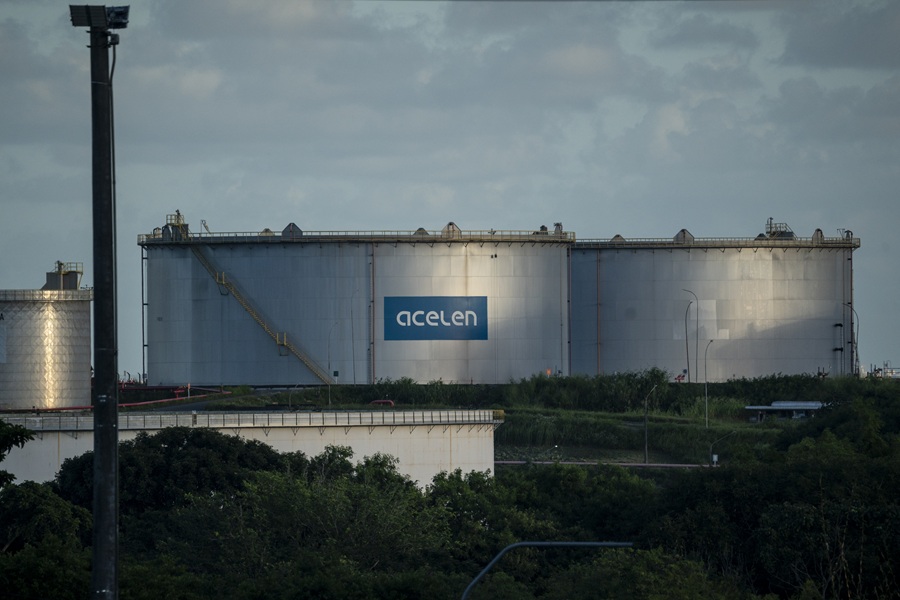
Tanks at the Mataripe oil refinery, located in the municipality of São Francisco do Conde (Photo: Fernando Martinho/Repórter Brasil)
Complaints from Traditional Communities
Acelen already has macaúba plantations in the municipality of Cachoeira (Bahia), near the future plant. However, quilombola and shellfish-harvesting communities living close to the plantations complain about the installation of fences and signs restricting access to areas historically used by quilombolas for extractive activities and religious practices.
According to residents, these territories have been taken over by macaúba cultivation, and nearby roads—already marked by potholes—have deteriorated further due to the circulation of Acelen trucks and tractors since planting began in 2025.
The complaints led Brazil’s Federal Public Prosecutor’s Office (MPF) to open an investigation into whether the project violates the right of traditional communities affected by the future biorefinery and macaúba plantations to free, prior, and informed consultation, as guaranteed un