
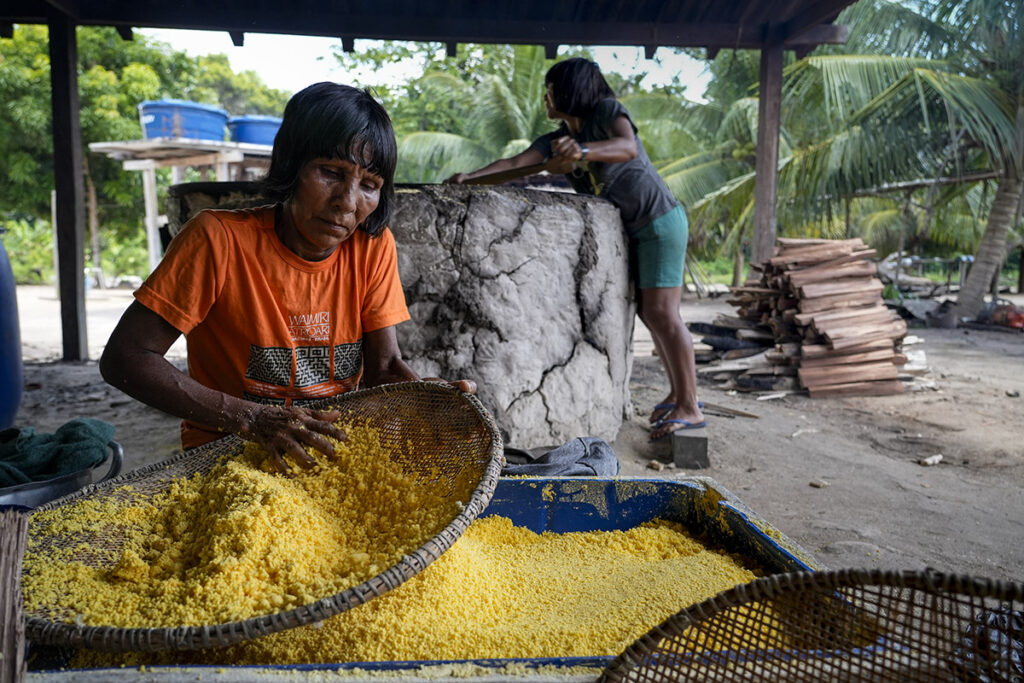
FROM THE WAIMIRI ATROARI INDIGENOUS LAND (AMAZONAS STATE, BRAZIL) – Akynamy no longer drinks from the river, choosing instead to bathe in a shower fed by well water, though the Alalaú river runs directly past her village. “I’m afraid to bathe in the river—it’s polluted, it’s dirty,” the elder laments.Her story is increasingly common among the Kinja, as the Waimiri Atroari people—living between Amazonas and Roraima—call themselves. They are neighbors of Mineração Taboca, which is responsible for one of Brazil’s largest open-pit mines.Since 1982, the company has operated in Presidente Figueiredo, Amazonas, and today is Brazil’s largest producer of refined tin—a metal that reaches the supply chains of automotive giants such as Toyota and Tesla.Akynamy’s concerns are well-founded. A stream feeding the Alalaú—the principal river of the Indigenous land—is reportedly contaminated with lead, arsenic, and other hazardous substances. That’s according to a report on water quality submitted by Brazil’s National Foundation for Indigenous Peoples (FUNAI) to Brazil’s Federal Public Prosecutor’s Office (MPF) in Amazonas in August 2025.
The report, produced by the biotech startup Aqua Viridi, warned these contaminants in the water and sediments posed an “immediate threat” to both the Waimiri Atroari and their environment. Repórter Brasil reviewed the document firsthand; this reporting was supported by the Pulitzer Center’s Rainforest Investigations Network.These findings led the MPF to revive its ongoing five-year investigation into whether mining is poisoning Indigenous lands. “FUNAI’s information proves there is a tangible impact on the territory,” said Fernando Merloto Soave, the Federal Prosecutor in Manaus.For over forty years, the Kinja have live with the destruction of their homeland. Now, a new threat looms: a mineral rush fueled by the energy transition is driving new demand in the Amazon, adding pressure on the Waimiri Atroari, whose population was nearly annihilated in the 1970s during the construction of the BR-174 highway.Mineração Taboca continues to mine cassiterite—the main ore for tin—alongside tantalum and niobium, and is now exploring ways to extract rare earth elements. These minerals are coveted by the arms and technology sectors worldwide. In 2024, the company was acquired by China Nonferrous Metal Mining Group, a state